








































































Velcro in shoes can be scary or helpful
„Zip without zip", was first time named in popular newspaper column of journalist Sylvia Porter in american Post in 1958. It saw the light of day already in the 40s of the last century, thanks to the Swiss engineer Georg de Mestral. After one walk in the mountains with his dog, he discovered that parts of the Arctium plant had stuck to his clothes and the dog's fur. When he looked at it with a microscope, he discovered that the plant, which is known for spreading its seeds like this, has small hooks on its fruits with the ability to attach itself to surrounding objects. Like a true engineer, he set about researching this fact and a few years later he managed to create an artificial fiber on this principle, a fabric that consisted of two parts - one that has miniature hooks and the other that has sufficiently large meshes or let's call it loops that can be caught by the hooks precisely with their size. One part of the fabric is thus firmly attached to the other, and the whole process can be repeated even after tearing from each other. Welcome first form of so-called Velcro!

From the Swiss mountains to space
De Mestral's first experiments were with cotton. However, the cotton frayed and wore out in a relatively short time. As a result, De Mestral began researching the use of synthetic fibers, believing they would provide a more durable product. At the end De Mestral chose nylon claiming that it does not "disintegrate" easily and also does not attract mold, is non-biodegradable, and could be produced in fibers of various thicknesses. The idea worked, in 1955, he received a patent for his invention in Switzerland. Thanks to this, he was able to open his stores in several countries of Western and Northern Europe, in Canada and later in the United States. It is said that while the inventor was alive, an average of 55 million meters of velcro per year were sold.
At that time, the promotion of his invention was mainly helped by NASA, which incorporated velcro into the astronauts' spacesuits, who could comfortably and quickly get dressed or attach objects not subject to gravity in space stations thanks to it. On the contrary, the US military, which found velcro to be attractive for use on their uniforms, eventually withdrew from it because the characteristic sound that accompanies the opening of the zipper interfered with the soldiers and the tactical quiet stay in the field.
Velcro in fashion and footwear
When velcro got more colors in the 60s, designers such as Pierre Cardin, André Courréges and Paco Rabanne also gave it chance in their futuristic fashion creations. At that time velcro was improved by adding polyester.
In 1978, when de Mestral's patent expired, cheap imitations of his product from Taiwan, China and North Korea quickly flooded the market. Currently, the trademark is the subject of more than 300 registrations in more than 159 countries. George de Mestral was inducted into the US National Inventors Hall of Fame for his invention.
Velcro is used really everywhere and has not escaped the world of clothing and footwear either. In the 80s, it was adopted by sports brands such as Adidas, Puma and Reebok, which incorporated it into their sneakers, which became a hit and not only in the children's footwear segment. Being easy to put on and take off got attractive and hook and loop fasteners became more important for a few years. However, the bubble burst quickly and the sports and shoe industry also returned to the elements of lacing and the creation of the so-called slip-on shoes.
Pros and cons
Therefore, velcro appears in the minority in sports shoes, it is especially prevalent in children's collections, which of course balances the fact that children need to grow up to be able to deal with laces. Velcro is also popular in children's winter shoes, and we expect that it will not disappear so easily due to its practicality. It also serves people with disabilities, the elderly, and anyone who may find it difficult to wear shoes with laces and zippers.
It must be said here that the fact that the material accumulates dust, traps hair and lint contributed to the expulsion of velcro from clothes and shoes. Loops may stretch or break after prolonged use. The zipper unintentionally catches on other parts of the clothing, e.g. to sweaters. If you want to peel off the velcro, the clothes may be damaged. In addition, the zipper, when used close to the skin, absorbs moisture and sweat. Therefore, it must be regularly cleaned, ventilated and maintained.
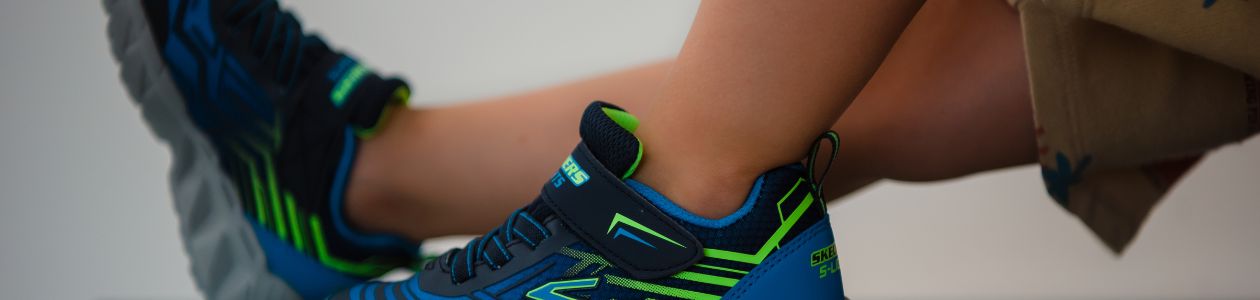
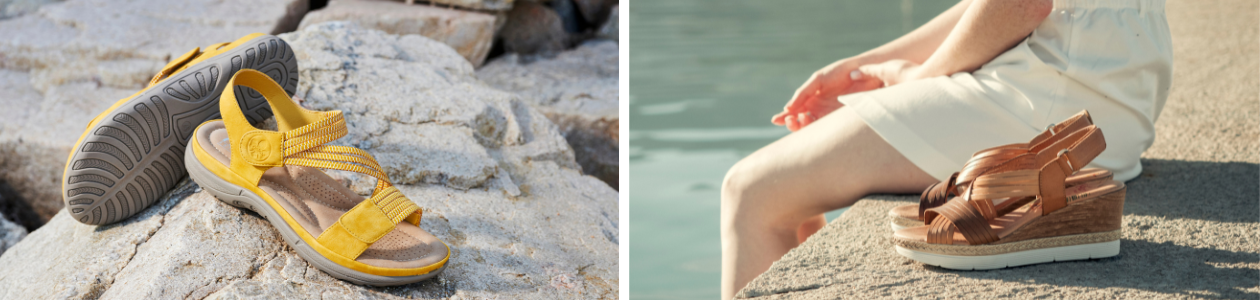
From all of the above, it can be said that velcro is a practical element in the footwear industry, but it is not one of the stylish or design gems. What is a "top" for one is a "no go" for another shoe wearer. However, we will find it at least in sneakers, Mary Jane ballet flats, sandals or winter shoes. If the designers are lucky, the velcro can fit the shoe. As in children's models Skechers and Dockers, which you can find in our e-shop as a novelty. Here you can safely give velcro a chance.


