

















































































What are AGO shoes? What shoes are "glued"?
Are you looking for new shoes and you can be surprised be all these shortcuts, expressing the quality of shoes in the form of technology? There are more and more of them and it is not always easy to find your way around them. Nevertheless, it´s worth following production trends, because how shoes are made will show you how they will serve you and, of course, how to take care of them.
One of the most critical production processes is attaching of upper part (upper) and the lower part (sole). This part of the production is important for the price, durability, easy repair or stability of the shoe. We suppose to pay attention to it just as we are noticing the material used.
Shoes can have:
- Glued sole
- Stitched sole
- Direct injection (of sole)

The most used and simplest process is gluing the sole. It has universal use because it can connect any sole with any upper at minimal cost. The upper and the sole can thus be produced separately and combined as desired. Gluing shoes is the cheapest, but it has its drawbacks. Improper gluing, applying glue, can, of course, cause the sole to peel off. Even with more expensive brands, this cannot always be avoided, and this defect, if it already occurs, is not irremediable. The strength of the glued joint is often negatively affected by soaking or sweating the shoes.
AGO abbreviation is often used in connection with glued soles: AGO shoes, AGO footwear, AGO production ...
AGO is just the aforementioned fast manufacturing process that can be used on all types of shoes. The name comes from name of the glue used for this production technique. Italian leather mechanic Dr. F. Rampichini developed this glue based on collodion wave around 1911, with the aim of bonding leather to leather firmly and permanently. Rampichini called this innovation "Another Great Opportunity". The style largely replaced the time-consuming production of sophisticated sewn shoes in the 1920s.
AGO shoes in the past and today
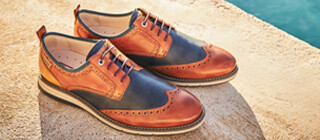
Today, the vast majority of footwear is produced using the AGO method. AGO shoes are light and form stable. As a rule, an insole is inserted into the shoes, under which staple bags can be seen. Adhesive residues are occasionally visible on the edge between the leather upper and the sole. Unlike in the past, AGO technology does not only glue leather materials today. Of course, it is also widely used in the production of sports shoes, sneakers, which use light synthetic soles in conjunction, for example. with textile uppers. Synthetics, improvisation and imaginative design are given green light!
Detached accidents
No type of glued shoe is perfect, and your shoes may also have a shortcoming in the form of a partial peeling of the sole. As long as this defect is minimal, there is nothing easier than to buy a glue for shoes, usually one or two small interventions are enough and AGO shoes are as wearable as before. Understandably, it is neither desirable nor aesthetically pleasing to load detached parts for too long. Here, too, the sooner you hit, the better. Glued shoes are a compromise between price and quality, and provided you know their pros and cons, you can enjoy them to the fullest.


